Southend-on-Sea in the Great War by Clamp Frances
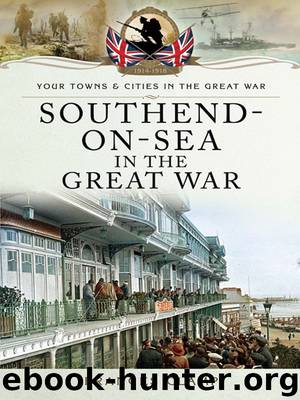
Author:Clamp, Frances
Language: eng
Format: epub
Tags: Bisac Code 1: HIS027090; Bic Code 1: HBWN; HISTORY / Military / World War I
ISBN: 9781473841307
Publisher: Pen and Sword
Published: 2014-10-30T16:00:00+00:00
A typical Officers’ mess of the Royal Flying Corps. (By kind permission of Stow Maries Great War Aerodrome)
To see why Britain relied so heavily on imported wheat for bread we need to go back to the 1870s and 80s. The weather had been poor for crop growing and, at the same time, cheap wheat from America started flooding the market. Essex was particularly badly hit, with its heavy clay soil which became waterlogged when it rained but baked hard during hot, dry spells. Farmers found it impossible to compete with the low priced imports and much farmland fell into disuse.
Developers moved in. Farms were sold cheaply and some purchased the land and divided it up into small plots. These were advertised in East London with offers to bring prospective purchasers by train to view them. The scheme was a great success and many, for a sum of as little as £10, became land owners for the first time. Former farms that had been sold in this way could not be returned to farming. Although they received no gas, electricity supplies and had no sewage arrangements many of the new owners built bungalows and moved in. The areas developed in this way became known as the Plot Lands. When the war came that land was no longer available for cultivation and, as many merchant ships were sunk, shortages became acute.
Yet even with all these problems the people of Southend still gave keen support to various charity collections, especially those involving help for the wounded in the local hospitals. The Southend and District Automobile Club offered to assist with transport. Colonel and Miss Kember of Runwell Hall invited wounded soldiers and sailors to their home for a third time. Patients went from Queen Mary’s Royal Naval Hospital, The Glen, The Overcliff and Victoria Hospitals and also from The Lady Hamilton Convalescent Home. The whole operation was run with military precision. The fleet of cars was due to depart from the various hospitals at 2.15 and 2.30 pm. They arrived at their destination shortly after 3 pm. The men were able to roam around the extensive grounds or play croquet, bowls, clock golf or other outdoor games. After tea they moved inside to be entertained with a concert in the drawing room.
Concerts were very popular at that time and obviously thought suitable for those recovering from war wounds. Another was organized at Stafford Hall in Southchurch Road, when seventy-five soldiers were entertained by the Misses Fergerson and Mr and Mrs Norwell. Afterwards there was a whist drive and, following tea, the visitors joined in with singing and recitations. This gives an interesting glimpse into the type of entertainment that was appreciated at that time.
Although some local people were still able to give generously to charity, others were facing extreme poverty. War was taking its toll on many families, with the main earner no longer at home.
As the year drew towards its close, so did the Battle of the Somme. This was the battle that produced the biggest casualty figures of the war on the Western Front.
Download
This site does not store any files on its server. We only index and link to content provided by other sites. Please contact the content providers to delete copyright contents if any and email us, we'll remove relevant links or contents immediately.
Shoot Sexy by Ryan Armbrust(17728)
Portrait Mastery in Black & White: Learn the Signature Style of a Legendary Photographer by Tim Kelly(17006)
Adobe Camera Raw For Digital Photographers Only by Rob Sheppard(16976)
Photographically Speaking: A Deeper Look at Creating Stronger Images (Eva Spring's Library) by David duChemin(16687)
Bombshells: Glamour Girls of a Lifetime by Sullivan Steve(14074)
Art Nude Photography Explained: How to Photograph and Understand Great Art Nude Images by Simon Walden(13046)
Perfect Rhythm by Jae(5403)
Pillow Thoughts by Courtney Peppernell(4284)
The Book of Joy by Dalai Lama(3986)
Good by S. Walden(3558)
The Pixar Touch by David A. Price(3438)
A Dictionary of Sociology by Unknown(3085)
Fantastic Beasts: The Crimes of Grindelwald by J. K. Rowling(3058)
Stacked Decks by The Rotenberg Collection(2883)
Humans of New York by Brandon Stanton(2873)
Read This If You Want to Take Great Photographs by Carroll Henry(2711)
On Photography by Susan Sontag(2639)
Insomniac City by Bill Hayes(2558)
Photographic Guide to the Birds of Indonesia by Strange Morten;(2534)
